If you harbour a romantic ambition to build a home conceived entirely by human intuition, designed before the machine quietly took over the drafting table, you are running out of time.
Walk through almost any architectural studio today, and artificial intelligence is already embedded in the workflow. It refines specifications, generates mood boards, tests solar envelopes, and automates documentation. Yet there is a critical distinction the industry often blurs: utilising AI as an instrument is entirely different from letting an algorithm lead design.
At WOLF Architects, our decision to keep generative AI out of the conceptual driver seat is not born of romantic nostalgia or stubborn luddism. The reality is far simpler: we are still far better at design than the machine.
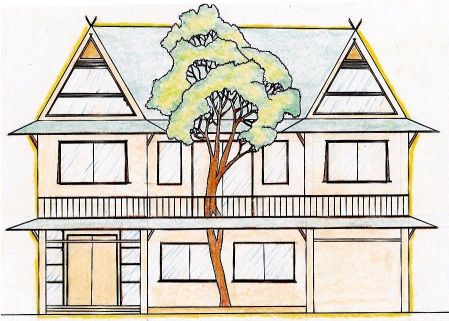
Every single home we create still begins the exact same way, with graphite on paper. We insist on hand sketches as the genesis of every project. When an idea is drawn by hand, it carries weight, friction, spatial instinct, and human pulse. From that perspective, our architecture functions almost like a handmade product, a tactile creation shaped by human sensibility rather than an aggregate of digital pixels.
Yet we are far from technophobes.
Our founder, Taras Wolf, was educated during a pivotal transition in architectural history, the exact moment the profession was shifting from hand drafted parallel bars and ink pens to computer aided design (CAD). Having straddled both eras, our studio embodies that unique duality. On one hand, we are unapologetically old school: we respect the raw artistry of the hand sketch and the physical reality of human proportion. On the other hand, we deploy the most advanced digital tools, 3D modelling environments, and computational platforms available.
It is precisely this synergy, the balance between old school artistic intuition and cutting edge technical precision, that creates the emotional resonance and atmosphere in our homes.
However, the broader landscape is shifting beneath the feet of the profession, propelled by two undeniable pressures.
When Clients Prompt the Brief
The first catalyst comes directly from the client. Homeowners no longer arrive at consultations with magazine clippings or Pinterest boards. Instead, they arrive with hyper rendered images generated overnight on Midjourney or DALL E. They present dramatic, impossible cantilevers and cinematic light shafts, asking: “Can we build something like this?”
An architect cannot simply dismiss this evolution. If our clients are actively dreaming through algorithms, we must understand the technology intimately, if only to translate fleeting digital hallucinations into buildable, compliant, and site responsive realities. When clients bring machines into the design conversation, the architect must master the medium to steer the project back to structural and human truth.
Architecture’s Open Secret: The 10% Rule
The second pressure cuts to the very core of architectural identity: the widespread myth that every architect is naturally gifted at conceptual design.
Within the industry, it is a well recognised reality that roughly 10% of architects within typical practices possess the genuine, intuitive gift for original design. That is the rare artistic eye that effortlessly balances volume, light, spatial rhythm, and proportion. The remaining 90% perform the equally vital, highly technical duties of practice, including town planning negotiations, contract administration, detailing, and coordination.
Generative AI will completely rewrite this balance.
By instantly synthesising aesthetic rules, structural precedents, and spatial typologies, AI will allow that 90% to dramatically lift their design output. Suddenly, generating a striking facade or a balanced floor plan will no longer require decades of cultivated artistic instinct. The algorithm provides an instant floor of baseline aesthetic competence.
The consequence is a rapid blurring of professional boundaries. When the barrier to generating photorealistic concepts evaporates, everyone enters the arena. Builders, structural engineers, draftspeople, and project managers will all have access to the same generative engines. Each will produce an instant, polished rendering and declare: “I can design your home.”
The Five Year Leap: From Pretty Pictures to Total Computation
Skeptics often comfort themselves by claiming AI is merely a surface level renderer that cannot understand the deep technical physics of building.
That defence is already crumbling.
Within the next five years, AI will not just generate atmospheric perspectives; it will resolve the entire computational ecosystem of a home. It will analyse complex soil mechanics, calculate dynamic wind loads, trace daylight penetration, model thermal mass, and optimise microclimatic orientation down to the millimetre. It will even master esoteric and cultural spatial philosophies, effortlessly balancing daylight vectors with the subtle spatial alignments of Feng Shui.
The machine will know how to optimise, calculate, and coordinate every measurable metric on site.
Yet calculating a house is not the same as understanding how a home feels.
The $10 Million Question: Liability, Instinct, and Feeling
It is easy to generate a breathtaking facade on a glowing screen, but are you 100% confident living inside it?
Do you truly trust an algorithm with a $10 million home?
Architecture is not an abstract digital exercise; it is an act of profound legal, financial, and physical responsibility. An algorithm does not care about water ingress, structural deflection, acoustic reverberation, or how concrete behaves as it cures under the harsh Australian sun. It carries no professional indemnity insurance. It cannot stand in front of a planning tribunal, nor does it bear the burden when a multi million dollar vision fails in reality.
An architect will always be required to vet, calibrate, and take responsibility for the design. But that safeguard relies entirely on one massive assumption: that the vetting architect possesses genuine, battle hardened experience.
You cannot confirm the feeling of a space through an algorithm. You can only verify it if you have built hundreds of houses. You have to have walked the muddy construction trenches, smelled the wet timber, felt the thermal shift as you step from a low ceiling threshold into a double height void, and watched living families inhabit your drawings over decades. That visceral, somatic knowledge cannot be downloaded or synthesised. It is earned through raw time, friction, and physical consequence.
The emerging generation of designers will never know that friction. Entering an industry where prompts replace trace paper and algorithms handle the heavy lifting, how will they ever develop that instinct? How will they acquire the spatial authority to question the machine when they have never worked without it?
The 70% Wipeout
This shift will trigger an existential reckoning. At WOLF Architects, we predict an approximate 70% wipeout of architectural firms operating under the traditional practice model.
This does not mean 70% of architects will suddenly be unemployed. Rather, the conventional business model of charging substantial fees purely to produce routine concept layouts, basic iterations, and standard drafting will become completely obsolete. Anyone attempting to sell ordinary design as an artisanal luxury will find themselves replaced by software in the hands of a builder or a client.
Practitioners will be forced to evolve or dissolve. Survival will not belong to those who resist technology, nor to those who merely use it to churn out faster, cheaper renders. It will belong to the master practitioners who operate in the singular realm algorithms cannot touch: deep emotional intelligence, tactile material mastery, and the authority to carry an ambitious vision from first sketch to structural reality.
Eventually, as algorithmic software achieves absolute fluency, hand sketching will cease to be a commercial necessity. We will sketch purely for leisure, passion, and artistic joy.
The Last Architects on Earth
This brings us to the ultimate question: Who will be the last architect?
Look at the demographics of the profession today. The mature cohort of practitioners currently running established studios, the generation sitting between 45 and 60 years of age, represents a rare, unrepeatable hinge in architectural history.
We are the ones who were trained before AI existed, and in many cases, before CAD took over the studio. We spent our formative decades learning space through graphite, razor blades, physical cardboard models, and hundreds of muddy construction sites. We possess the embodied memory of what space actually feels like in the flesh.
That generational clock gives us roughly another 10 to 15 years, perhaps 20 at the absolute limit, where true masters of the craft will still actively practise.
We are the last barrier between genuine human spatial intuition and algorithmic consensus. We are the last generation capable of looking a breathtaking AI creation dead in the face and knowing, from hundreds of built homes and decades of instinct, precisely what is profound and what is completely hollow.
Once this cohort lays down its pencils and steps away from the site, the critical tether will snap. Future generations will not evaluate the machine; they will be told by the machine what good architecture is supposed to be.
We are the last architects. For those who want their sanctuary sculpted by genuine human experience, spatial intuition, and handcraft before that lineage ends, the window is not merely closing. It is down to its final years.