What if the way we design garages is completely outdated?
For over a century, garages have followed the logic of the carriage house. A dark, isolated space pushed to the edge of the home, designed to hide something functional. That logic made sense for horses. It makes far less sense for modern engineering.
Today’s vehicles are not just machines. They are design statements, investments, and in many cases, works of art.
So why are they still being stored in spaces that were never designed to celebrate them?
In this episode, we explore how WOLF Architects is redefining garage design in Australia through customgarage.au. From museum quality lighting and acoustic tuning to seamless integration with living spaces, this is a shift from storage to experience.
If a masterpiece deserves a gallery, then perhaps it is time to rethink what a garage should be.
Transcript:
Host 1: Imagine for just a second that you’ve spent countless hours of your life researching something incredibly specific.
Host 2: Oh, yeah. The thrill of the hunt, right?
Host 1: You’ve scoured the earth for it, finally acquired it, and meticulously maintained this absolute masterpiece of human engineering.
Host 2: It becomes a real labor of love at that point.
Host 1: Exactly. You’ve poured your heart, soul, and a highly significant amount of your resources into this beautiful machine.
Host 2: Naturally.
Host 1: And now, the day is done, the sun is setting, you pull up to your house, and what do you actually do with this kinetic work of art?
Host 2: You hide it.
Host 1: You take it and park it inside this dark, damp, purely utilitarian concrete box.
Host 2: Yeah, it’s a bit sad.
Host 1: You shut a heavy metal door, turn off some flickering fluorescent light, and just leave it in the dark right next to half-empty cans of house paint and a broken lawn mower.
Host 2: It sounds almost tragic when you lay it out like that; we spend all this time and energy acquiring something beautiful only to lock it away in the architectural equivalent of a filing cabinet.
Host 1: Yes, and when you really stop to think about it, it is bizarre. But what if you completely changed the paradigm?
Host 2: Which is exactly what we’re looking at today.
Host 1: Today’s deep dive is about a radical new architectural movement spearheaded by the team at WOLF Architects and showcased on their new digital destination, CustomGarage.au. They are completely tearing down that dark concrete box mentality and replacing it with the ultimate automotive sanctuary.
Host 2: To understand why this movement is so necessary, we actually have to look backward for a moment. Why do we even build garages the way we do in the first place? The modern garage evolved directly from the 19th-century carriage house.
Host 1: Oh wow, of course.
Host 2: And the carriage house was detached and pushed all the way to the back of the property because horses smell, they attract flies, and they’re dirty. They needed to be quarantined.
Host 1: Yeah.
Host 2: We took that exact same architectural blueprint—this dark, isolated box meant to hold a smelly animal—and we just swapped the horse for a modern combustion engine.
Host 1: That is a massive light bulb moment. We are literally using 19th-century equestrian architectural logic for 21st-century masterworks of engineering.
Host 2: We’re hiding our engineering because of a centuries-old habit regarding livestock. That is wild, and that glaring disconnect is exactly what CustomGarage.au is actively trying to solve.
Host 1: Absolutely. Whether you’re a seasoned collector or just someone who appreciates exceptional design, stick around because this discussion is going to completely reframe how you look at the spaces we build for the things we truly value. The foundational philosophy hinges on a specific definition of what a car actually is to an enthusiast.
Host 2: Right. For someone with “petrol in their veins,” a car is never just a utilitarian mode of transport.
Host 1: No, it’s a profound personal passion and a highly tuned instrument. The natural logical conclusion is that a work of art deserves a gallery, not just a storage unit.
Host 2: Which makes total sense conceptually. Parking a meticulously crafted vehicle in a standard cinder block garage is basically like buying a priceless Picasso and then deciding to display it in your utility closet right behind the water heater.
Host 1: Exactly. But let me play devil’s advocate for a second: isn’t a garage fundamentally just a functional structure whose job is basically a survival mechanism—protecting the car from rain and thieves? Aren’t we slightly overcomplicating a room whose sole purpose is just keeping a roof over a vehicle?
Host 2: That is the traditional, strictly pragmatic view, but that’s merely survival, not celebration. If you just wanted to keep the rain off, a heavy-duty tarp technically works. What WOLF Architects is doing is shifting the focus entirely. While the garage must protect the car, stopping there is a massive missed opportunity for human experience. Here is the crucial insight: the true star of the show isn’t actually the car itself.
Host 1: Wait, really?
Host 2: No, it is the space built around the car. The psychology here is about treating the garage or a subterranean basement not as some forgotten afterthought, but as a central defining feature of the home itself. It elevates the mundane act of parking into a deliberate act of curation.
Host 1: I really love that phrase, “the act of curation”. But let’s get into the physical reality: how is this achieved in the real world?
Host 2: Every space showcased on CustomGarage.au is an original design concept applying high-end architectural principles—the kind usually reserved for living rooms or world-class museums—directly to the automotive world. Let’s take lighting as a prime example.
Host 1: Yes, they emphasize museum-quality lighting. Standard garage lighting is terrible; a cheap LED strip flickers on, casts harsh shadows, and washes out the color.
Host 2: Exactly. Standard lighting has a terrible Color Rendering Index (CRI), which literally robs the paint of its depth. When WOLF Architects design these spaces, they are manipulating photons to sculpt the vehicle.
Host 1: Sculpting with light, I like that.
Host 2: They use high CRI lighting to pull the true pigment out of the paint and they are incredibly precise with the angles. Instead of a blinding harsh glare bouncing off the clear coat from a downward spotlight, they use angled fused spots that highlight the aerodynamics and the curves. It makes the car look like it’s moving even when it’s standing completely still.
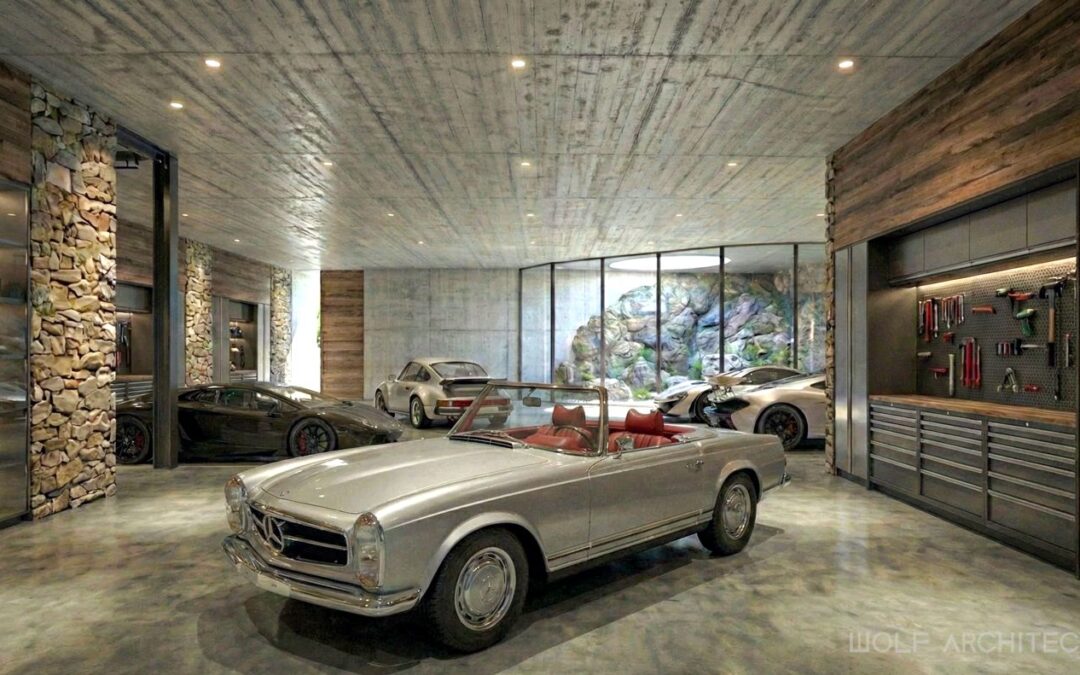
Host 1: It’s the difference between lighting a warehouse and lighting a stage. They pair that lighting with incredible materials too, using bespoke finishes like polished concrete contrasted with the warmth of luxury timber.
Host 2: It really warms up the space. But out of all the technical details, there is one feature that absolutely blew my mind: acoustic treatments.
Host 1: Why on earth does a garage need specialized acoustic engineering like you would find in a recording studio?
Host 2: Think about the physics of a standard concrete box garage. When you cold start a high-performance engine, the sound waves violently bounce off all those hard surfaces simultaneously, creating a deafening cacophony.
Host 1: It’s like an echo chamber. So, how do they fix it?
Host 2: By introducing acoustic diffusers to scatter those high-pitched harsh echoes and bass traps to absorb the muddy low-end boom. They are literally tuning the room as if the garage itself is an instrument.
Host 1: So instead of a harsh clatter, you get this perfectly tuned resonant growl. Starting the car becomes a highly curated auditory experience.
Host 2: It is the ultimate invisible luxury, like the difference between hearing a symphony in a dedicated concert hall versus a tiled public bathroom.
Host 1: Precisely. But having a perfectly tuned, beautifully lit room means nothing if it’s still banished to the far end of the driveway. Which brings us to the next massive evolution: integration.
Host 2: Right. It’s about how this sanctuary interacts with the rest of the owner’s life, moving from the internal environment of the garage to its external relationship with the rest of the home.
Host 1: They take the concept of the “man cave” and elevate it to the stratosphere. We are talking about subterranean basements that seamlessly blend vehicle display areas with luxury lounges, fully stocked bespoke bars, and sophisticated entertainment spaces.
Host 2: The garage is no longer a separate, isolated wing; it becomes the primary social hub of the estate.
Host 1: And the absolute pinnacle is the seamless integration concept using expansive glass walls that connect the garage directly to living spaces. You can be sitting in your living room or study and directly admire your collection. You are bringing the machine into the heart of the home.
Host 2: It’s like an incredibly high-end, life-sized terrarium or a piece of kinetic art built right into the architecture of your house. You’re on your sofa with a glass of scotch, and right there through a flawless glass wall is your beautifully lit, perfectly framed masterpiece.
Host 1: It completely reverses that 19th-century equestrian paradigm. You aren’t hiding the machine away; you are making it the absolute focal point of your daily domestic life.
Host 2: But architectural integration is only half of the equation. True car culture is an entire lifestyle that fills that container. To celebrate this, the site includes a dedicated hub devoted entirely to the Mercedes-Benz marque.
Host 1: It might seem niche at first, but the strategy makes perfect sense. They have deep dives into classic models, exploring the rigorous engineering history and the racing pedigree of things like the 1950s W196 Silver Arrow.
Host 2: Exactly. You aren’t just parking an old car; you are housing a piece of world history. And they pair that historical reverence with practical, everyday maintenance insights.
Host 1: Because if your vintage Mercedes is sitting in a beautifully lit, glass-walled gallery attached to your pristine living room, it cannot be leaking oil onto the polished concrete. The mechanical health of the car is directly tied to the aesthetic health of the room.
Host 2: But this brings up a natural question: is this exclusively a playground for eccentric billionaires?
Host 1: That is why their inclusion of collectibles and lifestyle features is so vital. They dedicate space to Mercedes toys, 1:18 scale models, and lifestyle accessories.
Host 2: Why does a high-end architecture firm care about a die-cast desk toy? Because they understand the democratization of the passion. The psychology of curation exists at every single scale.
Host 1: Taking the time to perfectly angle a scale model under a dedicated desk lamp uses the exact same psychological muscles as designing a subterranean hypercar gallery.
Host 2: It proves the site has a much wider universal appeal for any enthusiast wanting to create a dedicated shrine, regardless of square footage or budget. CustomGarage.au acts as a massive high-end mood board.
Host 1: We’ve moved decisively away from viewing the garage as a dark, utilitarian 19th-century storage box toward a vision of a bespoke, acoustically tuned sanctuary that integrates into our living spaces.
Host 2: The invitation is simple: pour yourself a coffee, head over to the site, and take a tour. You might just find yourself entirely rethinking what a garage is supposed to be.
Host 1: But before we officially wrap up, there is a philosophical question at the heart of this: the spaces we consciously design for our possessions ultimately reflect how much we truly value them.
Host 2: Right. A true masterpiece gets a carefully lit gallery.
Host 1: So if we accept that, what does it say about our modern relationship with these absolute marvels of transportation that our first instinct is still to build a windowless box, pull them inside, and firmly shut a heavy door to hide them from the world?
Host 2: Are we routinely hiding our own greatest ingenuity in the dark just out of sheer habit?
Host 1: It certainly changes the perspective next time you pull in and turn off the engine. Until next time, keep your curiosity fired up.